Breadcrumb > Progetti
CAULERPA CYLINDRACEA-EGADI PROJECT
What are the alien species?
By alien species (allochthonous or non-endemic), we refer to those species present in an area outside the common area of distribution (present or past), where they settle and create stable populations. The Mediterranean Sea, defined as a "sea under siege", due to the numerous and frequent biological invasions recorded in the last decades (Galil, 2000; Boudouresque et al., 2005; Rilov & Galil, 2009), is considered, at world level, the sea that hosts the largest number of macrophytes introduced
(Zenetos et al., 2012).
The introduction of an alien species may be due to natural or man-related causes. Anthropic causes can be divided into intentional or accidental. An intentional introduction is a deliberate introduction, generally of commercial nature (e.g. related to activities such as aquaculture, fishing, aquarium trade/fishkeeping or scientific research). Accidental introductions are mainly the result of ships' ballast water, fouling and opening of artificial channels, among which we recall the Suez Canal (1869), which caused the entry into the Mediterranean Sea of many alien species, defined as "lessepsian species" by the name of the engineer Ferdinand Marie de Lesseps. Also global warming, which is expected to facilitate the expansion of southern species towards north, might have in future significant effects on the introduction and distribution of alien species.
Not all species introduced, however, are capable of adapting and surviving the ecological conditions of the receiving habitat. In order that an introduced species can flourish within the new habitat, it must be able to establish stable populations. When the establishment and distribution of an alien species represent a threaten to the autochthon communities from an ecological, economic and health-related point of view, the introduced species is defined as an invasive one.
The success of an alien species may depend on several factors (Ribera & Boudouresque, 1995; Schaffelke et al., 2006), among which we recall the intensity of the phenomenon (e.g. frequency of vectors), the abiotic and biotic characteristics of the receiving environment and the ecological and physiological characteristics of the species introduced (e.g. high dispersal capacity, tolerability to extreme environmental conditions, genetic variability).
The introduction of alien species into marine ecosystems can have serious consequences at ecological level. In the new environment, the introduced species can: replace the indigenous species (such as key species or "keystone") (Boudouresque & Verlaque, 2002, Nyberg, 2007), cause a decline in biodiversity (diversity of species) or a loss of genetic integrity - by cross-contamination with native organisms - and alter the habitat structure. Among the around 1000 species of alien species present in the Mediterranean Sea (Zenetos et al., 2012), some invasive macro algae are of particular concern as they are able to alter the physical and chemical characteristics of the invaded habitats and interfere with biodiversity and the functioning of ecosystems (Williams & Smith, 2007). Among these species, the ones belonging to the Caulerpa genus are of major importance.
The invasive Caulerpe
The invasion of C. Taxifolia and C. Cylindracea, included among the "100 worst invaders" of the Mediterranean Sea (Streftaris & Zenetos, 2006), certainly has a special meaning for both the expansion of the invaded area and the effects on native communities. C. Taxifolia was observed for the first time in the Mediterranean waters just a few metres from the aquarium of Monaco in 1984, from where it had been accidentally released, while C. Cylindracea was observed for the first time in the Mediterranean Sea along the coasts of Libya in 1990. Recently, the presence of another Caulerpa in the Mediterranean has been reported (in Turkey in 2006 by Cevik et al., 2007; in south-east Sicily in 2007, as Caulerpa distichophylla Sonder by Meinesz et al., 2010) and identified by Jongma et al. (2013) as C. Taxifolia var. Distichophylla Sonder (Verlaque, Huisman et Procaccini), a recently introduced alien species from southern Australia, where it is endemic.
The successful invasion of C. Taxifolia and C. Cylindracea is related to their high ability to reproduce themselves in a vegetative and dispersive way (Meinesz et al., 1993; Piazzi et al., 1997). Both of them successfully colonize different types of substrate (rocky, shifting, mixed) from or at 40 m depth. (Boudouresque et al., 1995; Meinesz et al., 1995; Piazzi et al., 1997; Piazzi & Cinelli, 1999). The two Caulerpes tend to become dominant in the colonized areas, causing the decline of native communities (Verlaque & Fritayre, 1994, Piazzi et al., 2001). In the Mediterranean Sea, they are able to colonize many habitats, including the Posidonia oceanica prairies (Linnaeus) De¬lile. It has been observed that both the dead "mattes" of P. oceanica, consisting of dead rhizomes and sediment, and the turf communities appear to be more vulnerable to the colonization of these algae than canopy-forming algae or Posidonia oceanica prairies in good health (Ruitton et al., 2005; Bulleri et al., 2010, 2011; Katsanevakis et al., 2010).
The Caulerpae, also, produce secondary metabolites, called caulerpenyne, which they use to defend themselves against grazers or when they are in competition with other species. Although these metabolites make Caulerpae unattractive to most grazers, some taxa belonging to fish, molluscs and sea urchins feed on Caulerpae (Gianguzza et al., 2001, 2002; Ruitton et al., 2006; Azzurro et al., 2007 Klein & Verlaque, 2008). Among them, we find for example the sacoglossan ophistobranch molluscs belonging to Oxynoe and Elysia gender(Gianguzza et al., 2007). We have seen, for example, that Oxynoe succeeds in annulling the toxicity of caulerpenynes by transforming them into other molecules that are used as deterrent for predators (Gavagnin et al., 1994).
Caulerpa gender
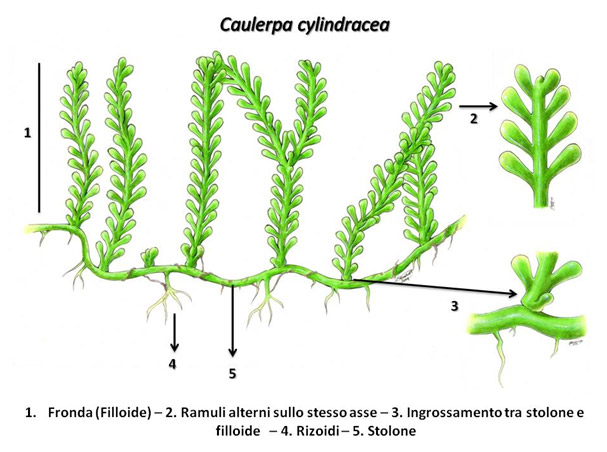
The Caulerpes (Ulvophyceae, Bryopsidales) are green siphonal algae characterized by the presence of a creeping stolon, from which below originate rhizoids, serving to anchor the thallus to the substrate, while above photosynthetic erect axes (phylloids or assimilators) of different forms bear side ramuli or pinnules. In the phylloid of Caulerpa cylindracea Sonder (formerly known as Caulerpa racemosa var. Cylindracea (Sonder) Verlaque, Huisman et Boudouresque) there are, for example, ramuli of vesicular aspect disposed radially or distichously along the axis, and it is also present an enlargement immediately above the junction of the phylloid to the stolon. Caulerpa taxifolia phylloid (M. Vahl) C. Agardh is instead characterized by the presence of pinnules arranged distichously along the axis.
The Caulerpes have a monogenetic diplontic reproductive cycle, which is characterized by olocarpia. It is in fact the entire cytoplasmic content of cells that gives origin to gametes. Once gametes are released simultaneously, the individual dies. The release of gametes is preceded by the appearance of small papillae on the phylloids (Hamel, 1930; Meinesz, 1973). The Caulerpes also reproduce vegetatively, by fragmentation of the thallus or by the formation of propagules.
Objectives
In view of the deep and sometimes dramatic impact from an ecological point of view that some alien species have on marine ecosystems, appropriate control and monitoring programs must be implemented, particularly in areas of naturalistic value such as the Reserves and the Marine Protected Areas (MPAs). Since a detailed knowledge of the presence of invasive species on the territory is indispensable with a view to prevention, a collection of basic data on the presence and invasiveness of the species is crucial in scientific research and in the definition of the intervention strategies. The shared project "Caulerpa cylindracea", of scientific and cultural interest, will last for two years and it consists in collecting data on invasive macroalga Caulerpa cylindracea Sonder (ex Caulerpa racemosa var. Cylindracea) within the "Egadi Islands" MPA. Thanks to this Project, it will be possible to follow the spread of this alien macro-algae within the "Egadi Islands" MPA and also create a database on the distribution and levels of threat. The Project also aims to raise public awareness - especially among the most relevant categories (fishermen, athletes, leisure boaters, etc,) - on the problem of these biological invasions, through an adequate information campaign.
To participate, simply send and/or communicate the alert together with the required information, by using one of the contacts below. You can also send photos. A paper form will be available at the MPA offices
Coverage% in an area of 20x20 cm
- (1-20%)
- (20-50%)
- (> 50%)